
This worksheet applies ratio reasoning to real-world modelling problems — scale drawings, recipes, mixing and sharing contexts — requiring students to formulate, solve and interpret each problem in context. The worksheet is split into warm-up questions, standard questions and then extension questions to test you.
The concepts it covers:
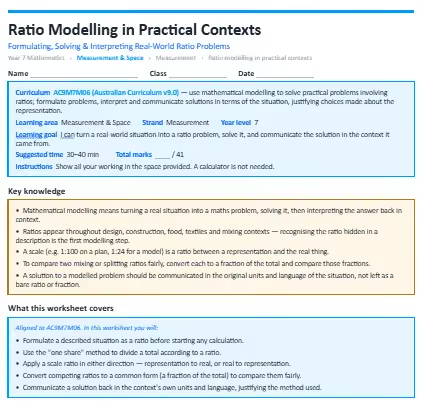
- Mathematical modelling means turning a real situation into a maths problem, solving it, then interpreting the answer back in context.
- Ratios appear throughout design, construction, food, textiles and mixing contexts — recognising the ratio hidden in a description is the first modelling step.
- A scale (e.g. 1:100 on a plan, 1:24 for a model) is a ratio between a representation and the real thing.
- To compare two mixing or splitting ratios fairly, convert each to a fraction of the total and compare those fractions.
- A solution to a modelled problem should be communicated in the original units and language of the situation, not left as a bare ratio or fraction.
What your child will practise:
- Formulating a described situation as a ratio before starting any calculation.
- Using the "one share" method to divide a total according to a ratio.
- Applying a scale ratio in either direction — representation to real, or real to representation.
- Converting competing ratios to a common form (a fraction of the total) to compare them fairly.
- Communicating a solution back in the context's own units and language, justifying the method used.
Every section opens with a worked example, and the download includes a full answer key with step-by-step solutions and teaching notes on the mistakes students most commonly make.
.webp)


.webp)
%20(1).webp)

