
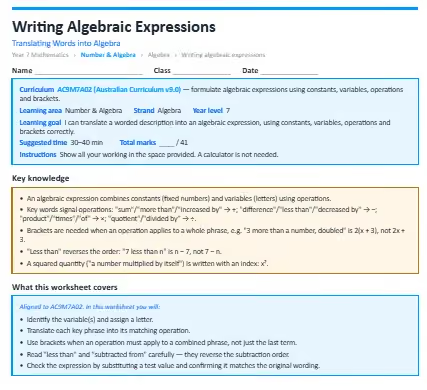
This worksheet builds early algebra skills, teaching students to translate worded descriptions into algebraic expressions using constants, variables, operations and brackets. The worksheet is split into warm-up questions, standard questions and then extension questions to test you.
The concepts it covers:
- An algebraic expression combines constants (fixed numbers) and variables (letters) using operations.
- Key words signal operations: "sum"/"more than"/"increased by" → +; "difference"/"less than"/"decreased by" → −; "product"/"times"/"of" → ×; "quotient"/"divided by" → ÷.
- Brackets are needed when an operation applies to a whole phrase, e.g. "3 more than a number, doubled" is 2(x + 3), not 2x + 3.
- "Less than" reverses the order: "7 less than n" is n − 7, not 7 − n.
- A squared quantity ("a number multiplied by itself") is written with an index: x².
What your child will practise:
- Identifying the variable(s) and assign a letter.
- Translating each key phrase into its matching operation.
- Using brackets when an operation must apply to a combined phrase, not just the last term.
- Reading "less than" and "subtracted from" carefully — they reverse the subtraction order.
- Checking the expression by substituting a test value and confirming it matches the original wording.
Every section opens with a worked example, and the download includes a full answer key with step-by-step solutions and teaching notes on the mistakes students most commonly make.
.webp)


.webp)
%20(1).webp)

