
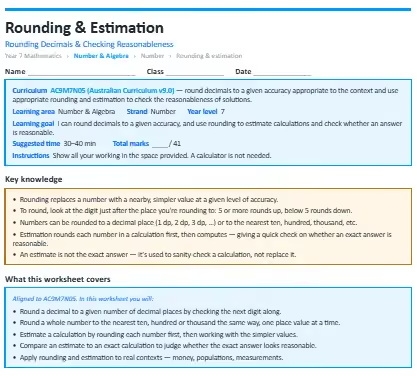
This worksheet builds practical number skills: rounding decimals to a given accuracy and using estimation to check whether a calculated answer is reasonable. The worksheet is split into warm-up questions, standard questions and then extension questions to test you.
The concepts it covers:
- Rounding replaces a number with a nearby, simpler value at a given level of accuracy.
- To round, look at the digit just after the place you're rounding to: 5 or more rounds up, below 5 rounds down.
- Numbers can be rounded to a decimal place (1 dp, 2 dp, 3 dp, …) or to the nearest ten, hundred, thousand, etc.
- Estimation rounds each number in a calculation first, then computes — giving a quick check on whether an exact answer is reasonable.
- An estimate is not the exact answer — it's used to sanity-check a calculation, not replace it.
What your child will practise:
- Rounding a decimal to a given number of decimal places by checking the next digit along.
- Rounding a whole number to the nearest ten, hundred or thousand the same way, one place value at a time.
- Estimating a calculation by rounding each number first, then working with the simpler values.
- Comparing an estimate to an exact calculation to judge whether the exact answer looks reasonable.
- Applying rounding and estimation to real contexts — money, populations, measurements.
Every section opens with a worked example, and the download includes a full answer key with step-by-step solutions and teaching notes on the mistakes students most commonly make.
.webp)


.webp)
%20(1).webp)

