
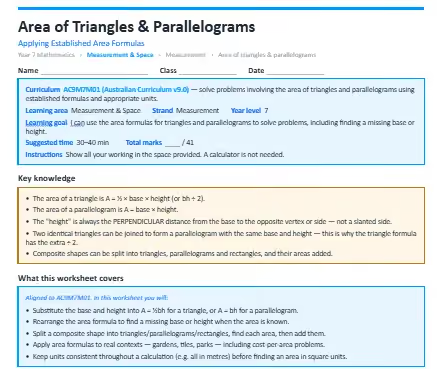
This worksheet applies established area formulas to triangles and parallelograms, including problems that work backwards to find a missing base or height. The worksheet is split into warm-up questions, standard questions and then extension questions to test you.
The concepts it covers:
- The area of a triangle is A = ½ × base × height (or bh ÷ 2).
- The area of a parallelogram is A = base × height.
- The "height" is always the perpendicular distance from the base to the opposite vertex or side — not a slanted side.
- Two identical triangles can be joined to form a parallelogram with the same base and height — this is why the triangle formula has the extra ÷ 2.
- Composite shapes can be split into triangles, parallelograms and rectangles, and their areas added.
What your child will practise:
- Substituting the base and height into A = ½bh for a triangle, or A = bh for a parallelogram.
- Rearranging the area formula to find a missing base or height when the area is known.
- Spliting a composite shape into triangles/parallelograms/rectangles, find each area, then add them.
- Applying area formulas to real contexts — gardens, tiles, parks — including cost-per-area problems.
- Keeping units consistent throughout a calculation (e.g. all in metres) before finding an area in square units.
Every section opens with a worked example, and the download includes a full answer key with step-by-step solutions and teaching notes on the mistakes students most commonly make.
.webp)


.webp)
%20(1).webp)

