
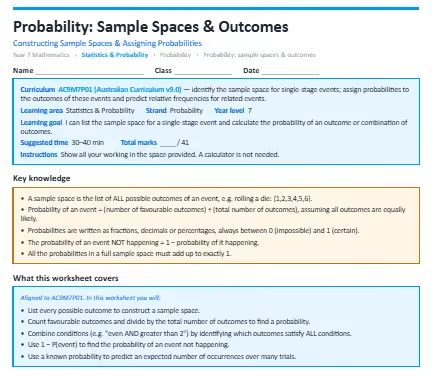
This worksheet introduces probability, teaching students to list the sample space for a single-stage event and calculate the probability of an outcome or combination of outcomes. The worksheet is split into warm-up questions, standard questions and then extension questions to test you.
The concepts it covers:
- A sample space is the list of all possible outcomes of an event, e.g. rolling a die: {1,2,3,4,5,6}.
- Probability of an event = (number of favourable outcomes) ÷ (total number of outcomes), assuming all outcomes are equally likely.
- Probabilities are written as fractions, decimals or percentages, always between 0 (impossible) and 1 (certain).
- The probability of an event not happening = 1 − probability of it happening.
- All the probabilities in a full sample space must add up to exactly 1.
What your child will practise:
- Listing every possible outcome to construct a sample space.
- Counting favourable outcomes and divide by the total number of outcomes to find a probability.
- Combining conditions (e.g. "even and greater than 2") by identifying which outcomes satisfy all conditions.
- Using 1 − P(event) to find the probability of an event not happening.
- Using a known probability to predict an expected number of occurrences over many trials.
Every section opens with a worked example, and the download includes a full answer key with step-by-step solutions and teaching notes on the mistakes students most commonly make.
.webp)


.webp)
%20(1).webp)

