
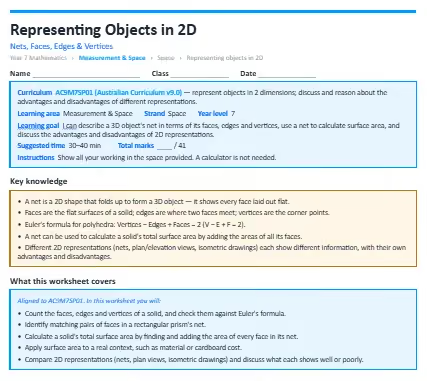
This worksheet introduces representing 3D objects in 2D, covering nets, faces, edges and vertices, and using a net to calculate a solid's surface area. The worksheet is split into warm-up questions, standard questions and then extension questions to test you.
The concepts it covers:
- A net is a 2D shape that folds up to form a 3D object — it shows every face laid out flat.
- Faces are the flat surfaces of a solid; edges are where two faces meet; vertices are the corner points.
- Euler's formula for polyhedra: Vertices − Edges + Faces = 2 (V − E + F = 2).
- A net can be used to calculate a solid's total surface area by adding the areas of all its faces.
- Different 2D representations (nets, plan/elevation views, isometric drawings) each show different information, with their own advantages and disadvantages.
What your child will practise:
- Counting the faces, edges and vertices of a solid, and check them against Euler's formula.
- Identifying matching pairs of faces in a rectangular prism's net.
- Calculating a solid's total surface area by finding and adding the area of every face in its net.
- Applying surface area to a real context, such as material or cardboard cost.
- Comparing 2D representations (nets, plan views, isometric drawings) and discuss what each shows well or poorly.
Every section opens with a worked example, and the download includes a full answer key with step-by-step solutions and teaching notes on the mistakes students most commonly make.
.webp)


.webp)
%20(1).webp)

