
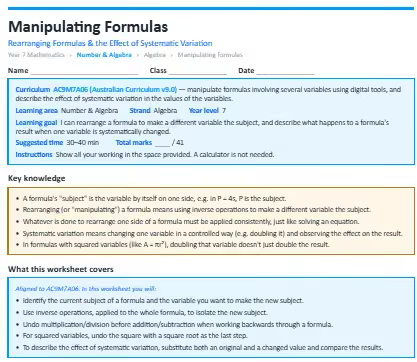
This worksheet builds algebraic fluency, teaching students to rearrange a formula to make a different variable the subject, and to describe the effect of systematically varying a formula's inputs. The worksheet is split into warm-up questions, standard questions and then extension questions to test you.
The concepts it covers:
- A formula's "subject" is the variable by itself on one side, e.g. in P = 4s, P is the subject.
- Rearranging (or "manipulating") a formula means using inverse operations to make a different variable the subject.
- Whatever is done to rearrange one side of a formula must be applied consistently, just like solving an equation.
- Systematic variation means changing one variable in a controlled way (e.g. doubling it) and observing the effect on the result.
- In formulas with squared variables (like A = πr²), doubling that variable doesn't just double the result.
What your child will practise:
- Identifying the current subject of a formula and the variable you want to make the new subject.
- Using inverse operations, applied to the whole formula, to isolate the new subject.
- Undoing multiplication/division before addition/subtraction when working backwards through a formula.
- Foring squared variables, undo the square with a square root as the last step.
- Toing describe the effect of systematic variation, substitute both an original and a changed value and compare the results.
Every section opens with a worked example, and the download includes a full answer key with step-by-step solutions and teaching notes on the mistakes students most commonly make.
.webp)


.webp)
%20(1).webp)

