
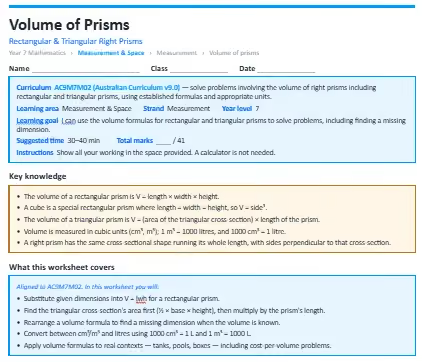
This worksheet applies volume formulas to rectangular and triangular prisms, including problems that work backwards to find a missing dimension. The worksheet is split into warm-up questions, standard questions and then extension questions to test you.
The concepts it covers:
- The volume of a rectangular prism is V = length × width × height.
- A cube is a special rectangular prism where length = width = height, so V = side³.
- The volume of a triangular prism is V = (area of the triangular cross-section) × length of the prism.
- Volume is measured in cubic units (cm³, m³); 1 m³ = 1000 litres, and 1000 cm³ = 1 litre.
- A right prism has the same cross-sectional shape running its whole length, with sides perpendicular to that cross-section.
What your child will practise:
- Substituting given dimensions into V = lwh for a rectangular prism.
- Finding the triangular cross-section's area first (½ × base × height), then multiply by the prism's length.
- Rearranging a volume formula to find a missing dimension when the volume is known.
- Converting between cm³/m³ and litres using 1000 cm³ = 1 L and 1 m³ = 1000 L.
- Applying volume formulas to real contexts — tanks, pools, boxes — including cost-per-volume problems.
Every section opens with a worked example, and the download includes a full answer key with step-by-step solutions and teaching notes on the mistakes students most commonly make.
.webp)


.webp)
%20(1).webp)

