
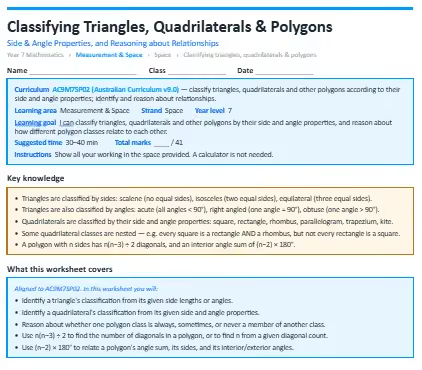
This worksheet builds geometric reasoning, teaching students to classify triangles, quadrilaterals and other polygons by their side and angle properties, and to reason about how different shape classes relate to each other. The worksheet is split into warm-up questions, standard questions and then extension questions to test you.
The concepts it covers:
- Triangles are classified by sides: scalene (no equal sides), isosceles (two equal sides), equilateral (three equal sides).
- Triangles are also classified by angles: acute (all angles < 90°), right-angled (one angle = 90°), obtuse (one angle > 90°).
- Quadrilaterals are classified by their side and angle properties: square, rectangle, rhombus, parallelogram, trapezium, kite.
- Some quadrilateral classes are nested — e.g. every square is a rectangle and a rhombus, but not every rectangle is a square.
- A polygon with n sides has n(n−3) ÷ 2 diagonals, and an interior angle sum of (n−2) × 180°.
What your child will practise:
- Identifying a triangle's classification from its given side lengths or angles.
- Identifying a quadrilateral's classification from its given side and angle properties.
- Reasoning about whether one polygon class is always, sometimes, or never a member of another class.
- Using n(n−3) ÷ 2 to find the number of diagonals in a polygon, or to find n from a given diagonal count.
- Using (n−2) × 180° to relate a polygon's angle sum, its sides, and its interior/exterior angles.
Every section opens with a worked example, and the download includes a full answer key with step-by-step solutions and teaching notes on the mistakes students most commonly make.
.webp)


.webp)
%20(1).webp)

