
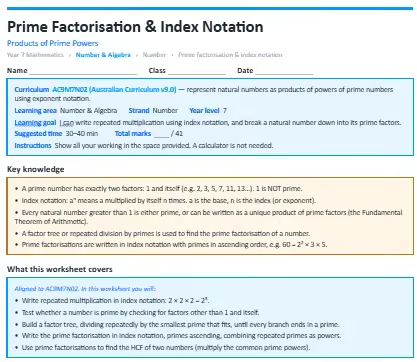
This worksheet introduces prime factorisation and index notation, teaching students to break natural numbers down into their prime factors and write repeated multiplication using powers. The worksheet is split into warm-up questions, standard questions and then extension questions to test you.
The concepts it covers:
- A prime number has exactly two factors: 1 and itself (e.g. 2, 3, 5, 7, 11, 13…). 1 is not prime.
- Index notation: aⁿ means a multiplied by itself n times. a is the base, n is the index (or exponent).
- Every natural number greater than 1 is either prime, or can be written as a unique product of prime factors (the Fundamental Theorem of Arithmetic).
- A factor tree or repeated division by primes is used to find the prime factorisation of a number.
- Prime factorisations are written in index notation with primes in ascending order, e.g. 60 = 2² × 3 × 5.
What your child will practise:
- Writing repeated multiplication in index notation: 2 × 2 × 2 = 2³.
- Testing whether a number is prime by checking for factors other than 1 and itself.
- Building a factor tree, dividing repeatedly by the smallest prime that fits, until every branch ends in a prime.
- Writing the prime factorisation in index notation, primes ascending, combining repeated primes as powers.
- Using prime factorisations to find the HCF of two numbers (multiply the common prime powers).
Every section opens with a worked example, and the download includes a full answer key with step-by-step solutions and teaching notes on the mistakes students most commonly make.
.webp)


.webp)
%20(1).webp)

