
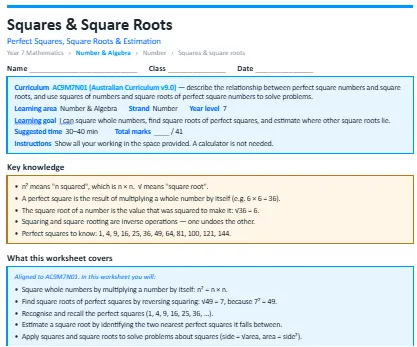
This worksheet strengthens a core Year 7 number skill: squaring whole numbers, finding square roots of perfect squares, and estimating where other square roots sit on the number line. The worksheet is split into warm-up questions, standard questions and then extension questions to test you.
The concepts it covers:
- n² means "n squared", which is n × n. √ means "square root".
- A perfect square is the result of multiplying a whole number by itself (e.g. 6 × 6 = 36).
- The square root of a number is the value that was squared to make it: √36 = 6.
- Squaring and square-rooting are inverse operations — one undoes the other.
- Perfect squares to know: 1, 4, 9, 16, 25, 36, 49, 64, 81, 100, 121, 144.
What your child will practise:
- Squaring whole numbers by multiplying a number by itself: n² = n × n.
- Finding square roots of perfect squares by reversing squaring: √49 = 7, because 7² = 49.
- Recognising and recall the perfect squares (1, 4, 9, 16, 25, 36, …).
- Estimating a square root by identifying the two nearest perfect squares it falls between.
- Applying squares and square roots to solve problems about squares (side = √area, area = side²).
Every section opens with a worked example, and the download includes a full answer key with step-by-step solutions and teaching notes on the mistakes students most commonly make.
.webp)


.webp)
%20(1).webp)

